
Calculation Point | 5/5/2026 | 4 min read
You’re watching a pitcher carve through a lineup, and the broadcaster mentions a 2.85 ERA. The crowd buzzes. But if you’re newer to baseball or even a seasoned fan who never dug into the numbers you might wonder: is that actually good? The answer depends on who’s pitching, where they’re pitching, and what level they’re at.
This article breaks down what a good ERA looks like across MLB, the minor leagues, college baseball, and fantasy rosters with real benchmarks, real names, and a clear framework you can use right now.
So, What Is a Good ERA in Baseball?
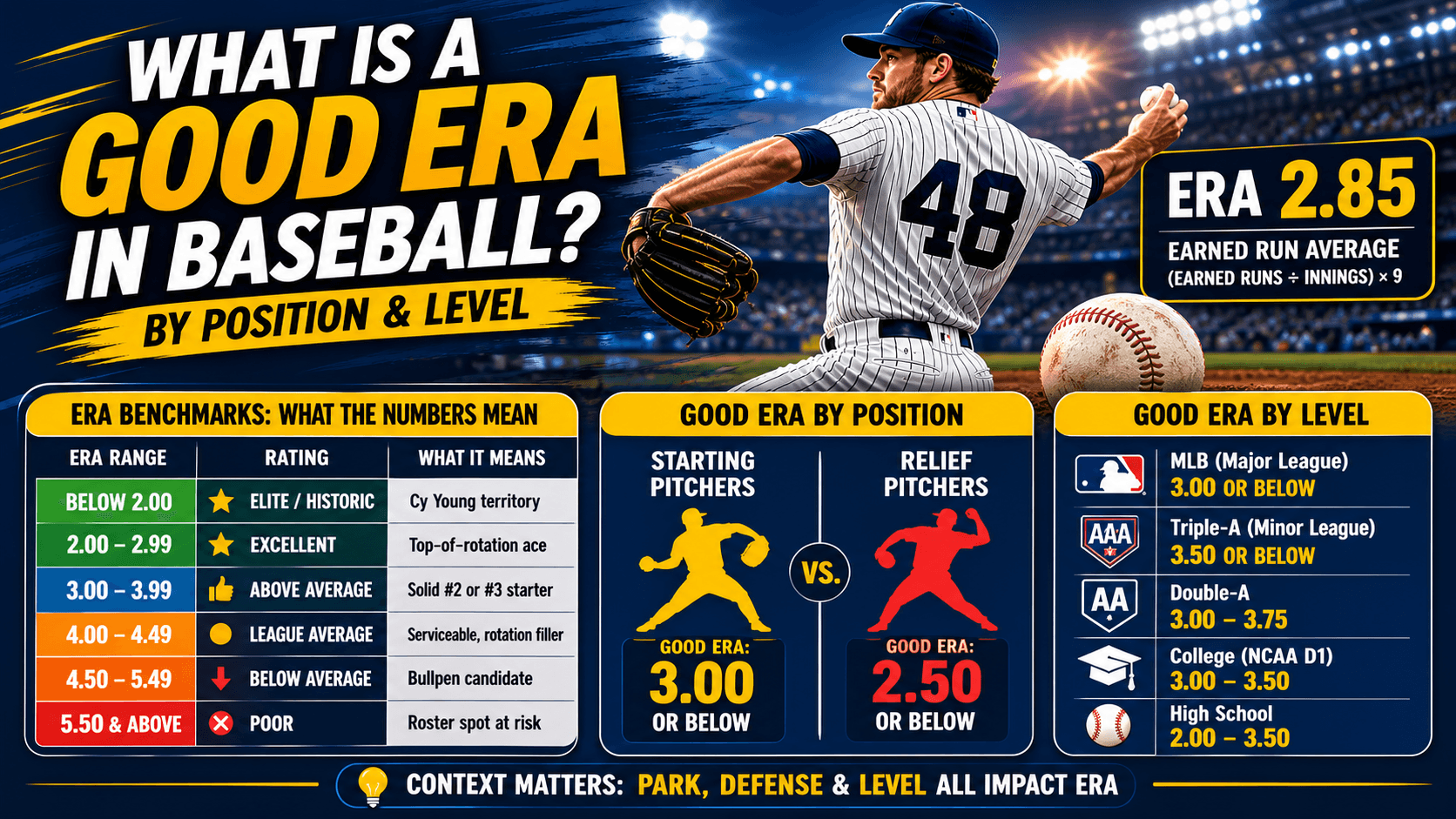
ERA (Earned Run Average) measures how many earned runs a pitcher gives up per nine innings. The formula is: (Earned Runs ÷ Innings Pitched) × 9.
In Major League Baseball, a good ERA is generally considered to be 3.00 or below. An ERA between 3.00 and 4.00 is solid. Anything above 5.00 is a concern for most starting pitchers. Elite aces like Jacob deGrom and Zack Wheeler have posted ERAs in the 2.00–2.50 range during peak seasons.
How Is ERA Calculated and What Does It Actually Mean?
ERA strips out unearned runs (those resulting from fielding errors) and focuses purely on what the pitcher is responsible for. One earned run over nine innings = a 1.00 ERA. Nine earned runs over nine innings = a 9.00 ERA.
Here’s the thing ERA doesn’t capture everything. It’s influenced by the quality of a pitcher’s defense, ballpark dimensions, and even plain luck on balls in play. That’s why analysts pair ERA with metrics like FIP (Fielding Independent Pitching) and xERA for a fuller picture.
That said, ERA remains the most widely used, universally understood pitching stat in the game. It’s the benchmark coaches, scouts, and fantasy managers reach for first.
ERA Benchmarks: What the Numbers Actually Mean
Use this table as your quick reference whenever you’re evaluating a pitcher:
| ERA Range | Rating | What It Means |
| Below 2.00 | Elite / Historic | Cy Young territory |
| 2.00 – 2.99 | Excellent | Top-of-rotation ace |
| 3.00 – 3.99 | Above Average | Solid #2 or #3 starter |
| 4.00 – 4.49 | League Average | Serviceable, rotation filler |
| 4.50 – 5.49 | Below Average | Bullpen candidate or spot starter |
| 5.50 and above | Poor | Roster spot at risk |
The MLB league-average ERA has hovered between 4.00 and 4.50 in recent seasons, according to Baseball Reference data. In 2023, the league ERA sat around 4.33 for starting pitchers.
What Is a Good ERA for a Starting Pitcher vs. a Relief Pitcher?
This distinction matters a lot and it trips up a lot of fantasy managers.
Starting pitchers face lineups multiple times per game. Hitters adjust as the game goes on, which means starters naturally allow more contact. A starter with a 3.50 ERA is performing well above average.
Relief pitchers face batters just once, often in high-leverage spots with fresh stuff. Because of this advantage, their ERAs run significantly lower. A reliever with a 3.50 ERA is actually middling. Elite closers like Emmanuel Clase or Josh Hader regularly post ERAs under 2.00 — sometimes dipping below 1.50 in dominant seasons.
Pro Tip: When comparing pitchers for fantasy baseball, always separate starters from relievers. A 3.80 ERA from your closer is a problem; the same number from your #4 starter is perfectly fine.
If you want to calculate ERA yourself or double-check a pitcher’s numbers mid-draft, the ERA Calculatorhttps://calculationpoint.com/sports/era-calculator lets you plug in innings and earned runs for an instant result no math required.
What Is a Good ERA at Different Levels of Baseball?
ERA benchmarks shift dramatically as you move down the competitive ladder. Run-scoring environments vary by level, so what looks like a bad MLB ERA can be an outstanding number in college or the minors.
MLB (Major League Baseball)
- Good: 3.00 or below
- League average: ~4.20–4.40
Triple-A (Minor League)
- Good: 3.50 or below
- Pitchers face older, more experienced hitters, so ERAs run higher than MLB in many cases due to prospect development focus
Double-A
- Good: 3.00–3.75
- Often considered the true test of whether a pitching prospect is legit
College Baseball (NCAA Division I)
- Good: 3.00–3.50
- Metal bats were replaced with BBCOR-standard bats in 2011, bringing college ERAs closer to the pro game
High School Baseball
- Good: 2.00–3.50
- Varies wildly by conference and region; context is everything
The further down you go, the more you need to adjust your expectations. A 4.50 ERA in Double-A from a 20-year-old prospect looks very different from a 4.50 ERA from a 28-year-old MLB veteran.
What Was Considered a Good ERA Historically?
ERA context changes across eras (no pun intended). The Dead Ball Era (roughly 1900–1919) saw league ERAs in the 2.00–3.00 range. The Steroid Era of the late 1990s pushed league averages well above 4.50. The Pitcher’s Era of 2012–2018 brought them back down.
A few historically great single-season ERAs:
- Bob Gibson, 1968: 1.12 ERA still the modern-era record
- Dutch Leonard, 1914: 0.96 ERA all-time record
- Jacob deGrom, 2018: 1.70 ERA over 32 starts the most dominant recent-era season
These numbers don’t just represent good pitching they represent once-in-a-generation performance that redefined what “good” means.
What Is a Good ERA in Fantasy Baseball?
Fantasy baseball adds another wrinkle. You’re not just evaluating a pitcher in isolation you’re managing a roster where ERA is a cumulative category across multiple pitchers.
Target ranges for fantasy teams:
- Elite fantasy ERA: Under 3.20
- Competitive fantasy ERA: 3.20 – 3.80
- Average fantasy ERA: 3.80 – 4.20
- Danger zone: Above 4.50
Streaming pitchers low-owned starters you pick up for one or two starts can tank your team ERA fast. One bad outing with 6 earned runs in 3 innings adds a 18.00 ERA to your weekly average.
Use the ERA Calculator at https://calculationpoint.com/sports/era-calculator to model how a potential pickup might affect your team’s cumulative ERA before you make the move. It’s a quick sanity check that fantasy managers overlook too often.
FAQ
Q: What ERA is considered elite in MLB?
A: An ERA below 2.50 is generally elite at the MLB level. Pitchers in this range are typically Cy Young contenders. Historically, ERAs below 2.00 over a full season are considered legendary achieved by fewer than a handful of pitchers in the modern era.
Q: Is a 4.00 ERA good in baseball?
A: A 4.00 ERA is roughly league average for MLB starters in recent seasons. It’s not bad it means a pitcher is holding their own but it’s not a profile that wins fantasy leagues or earns rotation-top billing. Context matters: a 4.00 ERA in a hitter-friendly park like Coors Field plays very differently than in a pitcher-friendly park.
Q: What is a good ERA for a high school pitcher?
A: At the high school level, a good ERA typically falls between 2.00 and 3.50, though this varies significantly by competition level, region, and opposing lineup quality. College scouts focus more on velocity, command, and pitch repertoire than ERA alone when evaluating high school arms.
Q: Can a pitcher have a low ERA and still be bad?
A: Yes, and this happens more than you’d think. A pitcher with a lucky strand rate or elite defense behind them can post a low ERA without actually performing well. Metrics like FIP (Fielding Independent Pitching) help reveal whether the ERA is sustainable or inflated by factors outside a pitcher’s control.